




 Traffic Hub
In the mobile user acquisition world, Day 7 (D7) has become the undisputed golden standard. It defines how budgets move, how campaigns scale, and how success is measured. This 168-hour window provides the ideal balance between data velocity and predictable performance.
However, the reason we cling to D7 is simple: it represents the current frontier of machine learning. Beyond this point, even the most advanced algorithms begin to hit a wall.
The Predictability Gap
Reliance on D7 isn't about the data disappearing after the first week. The signals are still there, but the complexity of predicting user behavior increases exponentially. As our lead buyer puts it: "D7 is the sweet spot for stability. Once you try to project further, the prediction accuracy drops, and the algorithm's efficiency inevitably declines."
When an algorithm tries to optimize for Week 2 or Week 3, the "noise" in user behavior makes it harder to maintain a stable CPA. This is often where scaling efforts stall - because the system reaches its structural limits in processing long-term intent.
We’ve explored these hidden limits of in-app auctions in detail, as they directly impact how far a campaign can actually grow.
Why Platforms Solidified the 7-Day Window
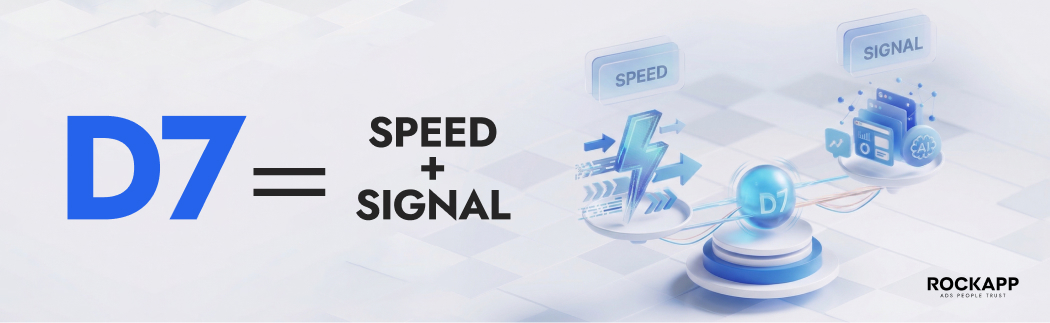
Ad networks prioritize high-velocity feedback loops to stay effective. Mintegral, for instance, established D7 ROAS targeting as an industry benchmark back in 2024 precisely to solve this. By focusing on a one-week horizon, they provide a stable environment where the machine has enough "fuel" to learn and optimize without the volatility of longer-term forecasts.
This creates a reliable system for managing cash flow. Advertisers can reinvest their capital quickly rather than waiting a month to see if a cohort eventually matures.
At the same time, some platforms have started moving beyond this model.
Networks like Moloco and Unity Ads are already testing optimization windows closer to D28–D30. These setups are still in limited rollout and mostly used in controlled environments, but the direction is clear.
Teams are looking for ways to extend the signal window without losing stability.
The "Hidden" Value in Longer Horizons
While D7 ensures stability, it can lead to a narrow focus on "fast-acting" users—those who deposit or subscribe almost immediately.
Industry data from Persona.ly shows that a massive layer of value develops after the initial acquisition phase. In certain cases, focusing on re-engagement and tracking conversions into Week 2 (W2) can boost ROAS by up to 400% compared to standard D7 models. This highlights a critical truth: the most valuable "whales" often take longer to reveal themselves than a standard algorithm is designed to wait.
How Top Teams Navigate the Standard

The best UA teams use D7 as a foundation, but they don't let it dictate their entire strategy. They bridge the prediction gap by:
- Feeding the Machine: Using D7 signals to keep the algorithm stable and the traffic flowing.
- Manual Maturity Checks: Regularly validating D7 cohorts against W2 and W4 retention to ensure the "fast" users are also high-quality users.
- Behavioral Proxies: Identifying early in-app milestones that serve as reliable predictors for 30-day LTV, essentially helping the algorithm see further than its default window.
The Bottom Line
D7 keeps campaigns manageable. It gives speed, control, and enough signal to move budgets with confidence.
But it also defines what the system learns to value.
When all decisions are tied to the first seven days, the algorithm keeps reinforcing the same type of users - the ones who act fast.
Everything else stays outside the loop.
Over time, that gap becomes visible in the only place that matters - in how much value your cohorts actually generate.