



A few years ago, the role of a media buyer was easier to define.
The core responsibilities revolved around traffic acquisition: launching campaigns, testing creatives, adjusting bids, and looking for opportunities to increase volume while maintaining performance.
Today, the same title covers a much wider range of responsibilities.
A media buyer may start the morning by reviewing campaign performance and end the day discussing attribution logic with an MMP, investigating traffic quality issues, validating CRM data, reviewing postback setups, and coordinating technical questions with a traffic source.
The campaign itself remains important.
The environment around the campaign has become equally important.
As acquisition systems expanded, media buying evolved into a role that sits somewhere between growth, analytics, operations, product, and technical infrastructure.

Every new source added to an acquisition setup brings more than additional reach.
It also introduces new integrations, new data flows, new reporting requirements, and new opportunities for discrepancies between systems.
A campaign may generate conversions inside an advertising platform, while the tracker reports different numbers and the CRM tells a third story altogether.
None of these systems are necessarily wrong. They simply observe the same user journey from different perspectives.
Understanding why those differences appear and how they affect optimization has become part of the daily workflow.
As acquisition setups grow, a larger share of the work shifts toward maintaining visibility across the system rather than managing campaigns in isolation.
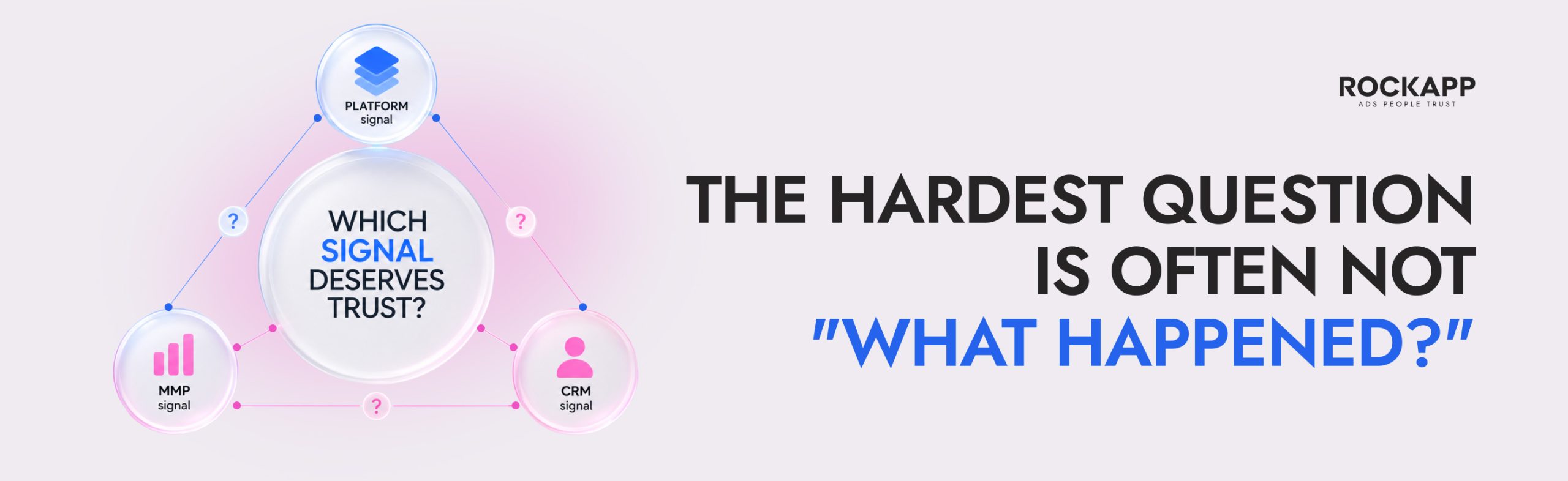

It is “Which signal deserves trust?”
Most acquisition teams work with several layers of reporting at the same time.
Platform dashboards show one version of performance. The MMP provides attribution data. Internal analytics adds another perspective. CRM systems reveal what happens further down the funnel. The challenge comes when those layers stop telling the same story.
A source may look profitable according to platform metrics while downstream revenue shows a different trend. Retention may improve while acquisition costs increase. Traffic quality may appear stable until cohort analysis reveals a shift in user behavior.
In these situations, optimization becomes impossible without first understanding where the discrepancy comes from.
Before a team can decide what to scale, it has to understand what is actually happening inside the system.


Attribution used to be something many teams reviewed after campaigns had already launched. Today, it influences almost every important decision.
Every optimization event, every postback, every conversion window, and every attribution rule affects how performance is interpreted.
As more channels participate in the same customer journey, attribution becomes less about reporting and more about operational clarity.
A media buying team may spend hours investigating a performance shift when signals across platforms, attribution systems, and product analytics stop aligning. In many cases, the challenge is not the campaign itself, but understanding how data moves through the acquisition infrastructure and where a change inside the measurement setup affects performance interpretation. This is why integration knowledge became an important part of modern media buying.


Traffic quality monitoring follows a similar path. The conversation is no longer limited to identifying invalid installs.
Teams increasingly evaluate traffic through behavioral signals, cohort quality, retention patterns, monetization data, and downstream events.
The goal is understanding whether acquired users behave the way the product expects them to behave. This requires continuous validation across multiple systems and datasets. The investigation itself often becomes part of the optimization process.
In many cases, understanding the quality of traffic creates more impact than adjusting bids or launching another campaign variation.


Growth still comes from finding new opportunities, testing new ideas, and expanding successful campaigns.
The difference is that every new opportunity enters a system that has become significantly more complex than it was a few years ago.
The teams that consistently produce strong results are rarely the teams launching the highest number of campaigns.
They are the teams that understand how their acquisition systems behave, how data moves between platforms, where performance signals originate, and how to maintain clarity as complexity grows.
Growth remains the objective.
Understanding the system became one of the main ways to achieve it.


